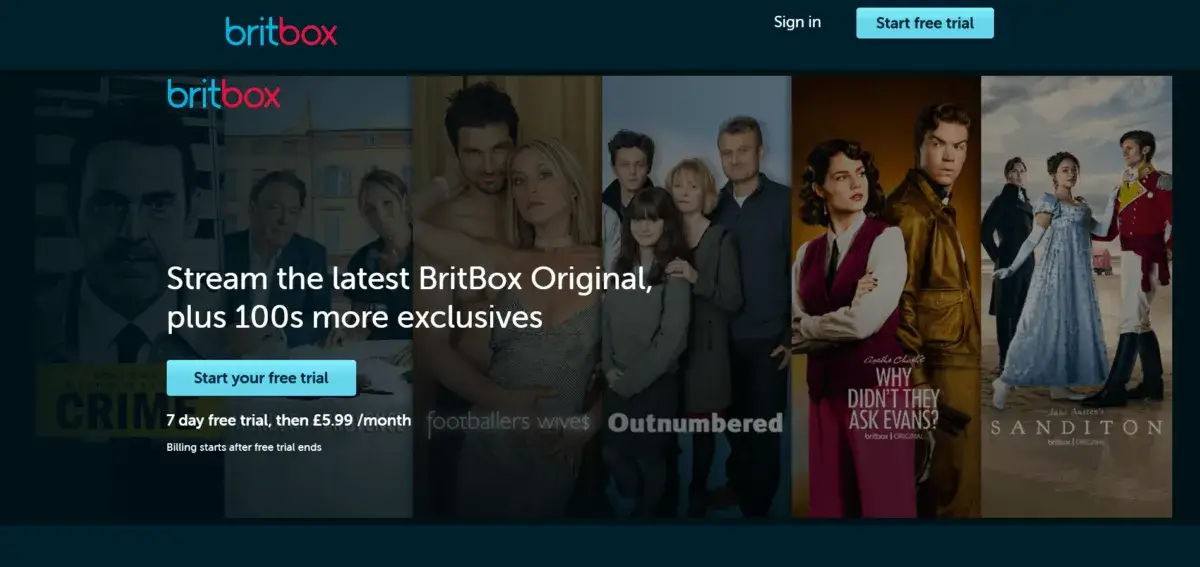
If you are looking for BritBox in the UK, there is something you need to know first: BritBox closed as a standalone UK service on 30 April 2024. Its programmes did not disappear. They moved into ITVX Premium, which is where you now watch them.
BritBox still runs as a separate service in other countries, including the United States, Canada and Australia. This guide covers the UK, so from here on it deals with ITVX Premium, which is where the BritBox catalogue lives.
What happened to BritBox in the UK
BritBox was launched by the BBC and ITV as a home for archive British television. ITV later folded it into its own streaming service. New subscriptions stopped being sold, the app was retired, and the catalogue was absorbed into the paid tier of ITVX.
The practical effect for viewers is that the programmes people signed up for, such as classic drama and comedy from the BBC and ITV archives, are now behind ITVX Premium instead of a separate BritBox subscription. If you had a BritBox account, it will have been dealt with at the time of the move.
What broadband speed do you need?
Streaming British archive television is not demanding. Most of this catalogue was made long before 4K existed, so a great deal of it streams in standard or high definition rather than anything more taxing.
As a rough guide for any mainstream streaming service:
| Quality | Speed needed, per stream |
|---|---|
| Standard definition | Around 3 Mb |
| High definition | Around 5 to 8 Mb |
| Ultra HD, where available | Around 15 to 25 Mb |
The important word there is per stream. The figures are not a household total. If someone is watching in one room while someone else streams in another, you need both allowances at the same time, plus headroom for everything else on the connection.
In practice almost any modern broadband package clears these numbers comfortably. If you are on full fibre, or even a mid range part fibre package, speed is very unlikely to be your problem.
If it buffers anyway
Buffering on a connection that is fast enough is nearly always a wifi problem rather than a broadband one. The speed arriving at your property and the speed reaching your television in the back bedroom can be very different numbers.
The quickest way to tell them apart is to run a speed test twice: once on a device plugged into the router with a cable, and once on the device you actually watch on, sitting where you normally watch. If the wired result is healthy and the wireless one is not, the fix is your wifi rather than your package. Our guide to boosting your home wifi signal covers what to do about it.
A few other things cause the same symptom:
- Someone else on the connection uploading or downloading something large in the background.
- An older smart TV or streaming stick that cannot use the faster wifi bands, so it connects slowly regardless of your broadband.
- Peak time congestion between roughly 8pm and 10pm, when everyone locally is online at once.
- A problem at the service rather than at your end, which affects everyone and resolves itself.
Watching on more than one screen
Streaming services limit how many screens can watch at once, and that limit is set by your subscription rather than by your broadband. Your connection governs whether those streams play smoothly, not whether you are allowed to start them.
If several people in the house watch at the same time, add the per stream figures together and treat that as your minimum. A household running two HD streams while someone works from home is asking for perhaps 20 Mb at once, which is still modest by current standards.
If your broadband really is the limit
If a wired speed test comes back well below what you pay for, the problem is the line or the package rather than the streaming service. Our guide to speeding up slow broadband works through the likely causes in order.
If the line is simply as good as it gets, it is worth checking whether anything better has reached your street. Full fibre has expanded quickly and many addresses now have options they did not have a couple of years ago. Check what is available at your address, compare full fibre deals, or see our guide to what broadband speed you really need before deciding how much to pay for.