
What is fibre broadband?
Fibre broadband uses fibre optic cables to send data, meaning the signal travels as light rather than as an electrical impulse. There are two main types, and the difference between them matters a lot for the speed you’ll actually get.
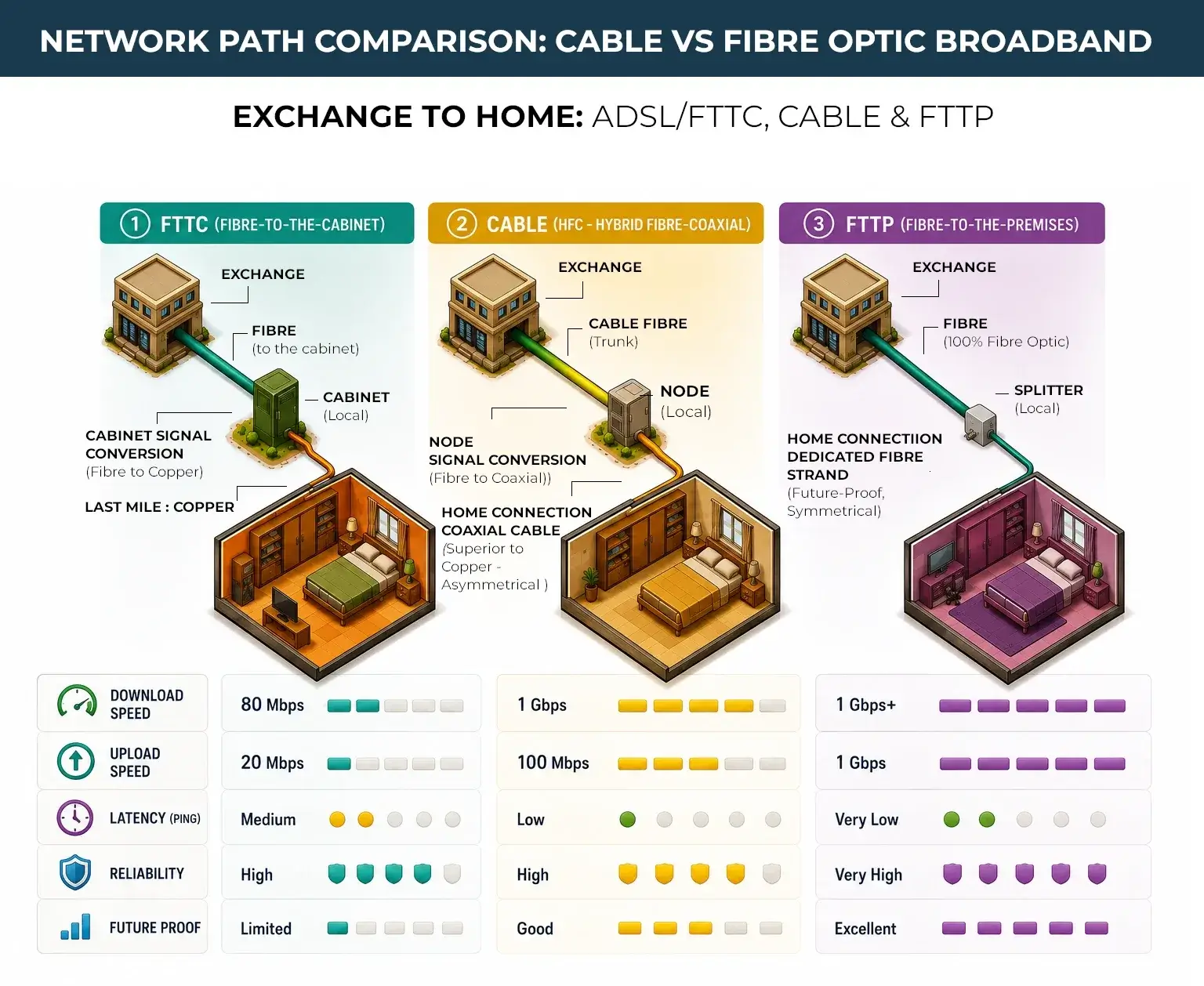
Fibre to the Cabinet (FTTC) uses fibre optic cable from the exchange to your local street cabinet, then switches to the existing copper phone line for the final stretch to your house. This copper “last mile” is the bottleneck it caps FTTC speeds at around 80Mb per second, and speeds degrade further the greater the distance between your home and the cabinet.
Fibre to the Premises (FTTP), also called full fibre, runs fibre optic cable all the way into your home with no copper involved at all. This removes the distance-related speed loss altogether and enables much higher speeds, typically 100Mb up to 1000Mb (1Gb) per second, with some providers now offering multi-gigabit packages. Full fibre has expanded significantly in recent years and is now available to the majority of UK homes, so it’s well worth checking availability at your address rather than assuming it’s a niche or unavailable option.
What is cable broadband?
Cable broadband is provided by providers like Virgin Media. Most of the connection is still made up of fibre optic cable the difference from FTTC comes down to that final stretch into your home. Where FTTC relies on the existing copper phone line for this last link, cable broadband uses coaxial cable instead, which carries data faster than copper phone cable and loses less signal over distance.
What difference does this make?
At the time of writing, cable and full fibre broadband are both comfortably faster than FTTC. FTTC tops out at around 80Mb per second, fine for most everyday use, but increasingly the entry-level option rather than the fast one. Virgin Media’s cable network now offers packages ranging from around 130Mb up to over 1,100Mb (1.1Gb) per second, with a faster tier available in some areas offering over 2Gb. Full fibre (FTTP) providers, meanwhile, offer speeds typically from 100Mb up to 1000Mb per second or more, depending on the provider and package.
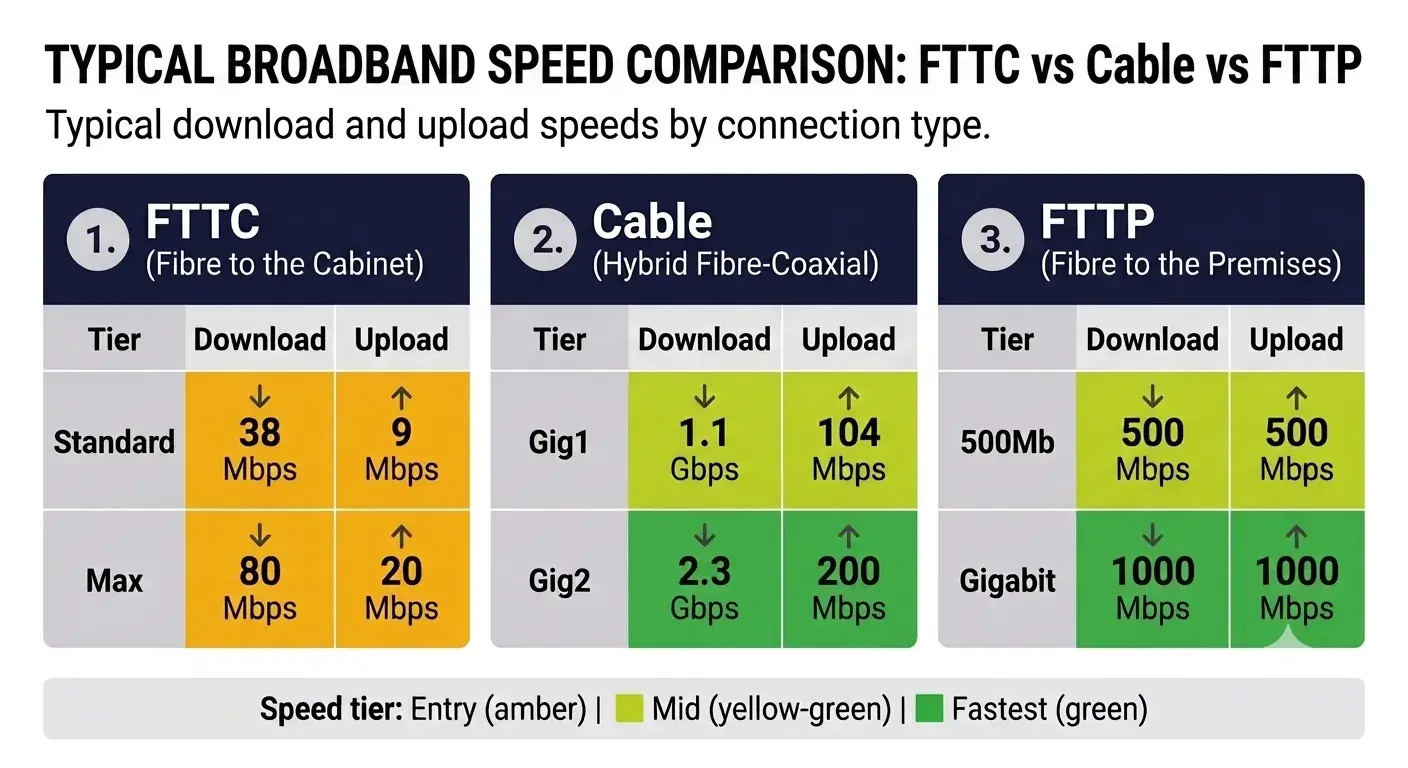
One difference worth knowing about: upload speed. Cable connections typically offer much slower upload speeds than download speeds, often a small fraction of the headline figure. Whereas full fibre connections frequently offer symmetrical or near-symmetrical speeds, meaning uploads are close to as fast as downloads. This matters more than it used to, given how much video calling and cloud backup most households now do, so it’s worth checking the upload figure specifically rather than just the headline download speed.
Both cable and fibre broadband are available at speeds that are fast enough for most people’s purposes, but what you’re paying for can differ from what you get in real life, because the quoted speed is only theoretical. Your actual speed will vary depending on your location, how far you are from the exchange or cabinet (for FTTC), the type of building you live in, and the technology used locally. Once you sign up, you’ll get a more accurate picture of the speed you’re actually getting.
Cost
The speed of your broadband normally dictates how much you pay, though this isn’t as fixed a rule as it used to be, full fibre broadband has become increasingly price-competitive with cable at comparable speeds, so it’s worth comparing both rather than assuming one is automatically pricier. You may also be subject to limits on how much data you can download in a calendar month with some providers, while others offer unlimited downloads as part of the price. You can use this postcode checker to check broadband availability in your area.
The Verdict
For most people, most broadband speeds will be more than enough. If you have multiple devices and use them for streaming and downloading large files, or regularly do video calls and cloud backups, then faster speeds, unlimited data, and strong upload speeds will make a genuine difference. It’s really up to you to decide how much you’re willing to pay for your broadband. There’s a wide range of providers offering better deals on broadband than others, so it’s worth shopping around until you find the best cost-to-performance ratio for you.