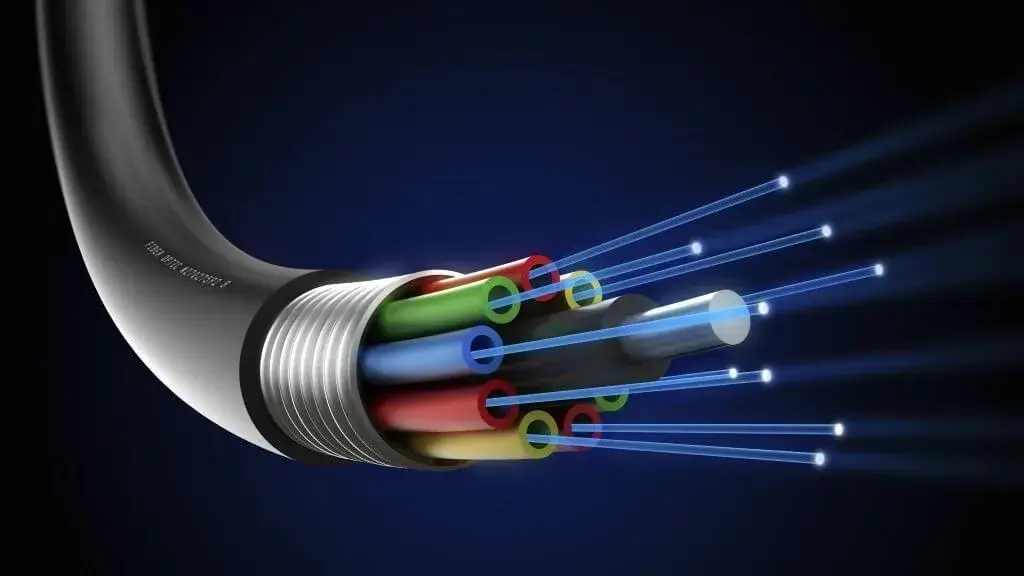
Fibre optics send information coded into a beam of light down a plastic or glass pipe. The technology was first used in the 1950s for endoscopes to help doctors see inside patient’s bodies without having to cut it open. During the 1960s engineers found a way to transmit telephone calls at the speed of light (186,000 miles per second) though in the real world it only travels at about a third of that speed.
Optical fibres as they’re known are made of silica glass or plastic. Plastic fibres are more durable but have more noise, meaning more errors when transmitting. These fibres are very thin and are typically a tenth of the thickness of a human hair. Each of these fibres can handle up to 25000 phone calls simultaneously. Typically, a fibre optic cable has hundreds of strands, so can handle millions of phone calls.
They work by carrying information as light in the form of a laser beam. This beam sends pulses multiple thousand times a second. At the other end, a photoelectric cell (this is sensitive to light) decodes this laser beam into digital information required for your computer.
So how does light travel down the cable?
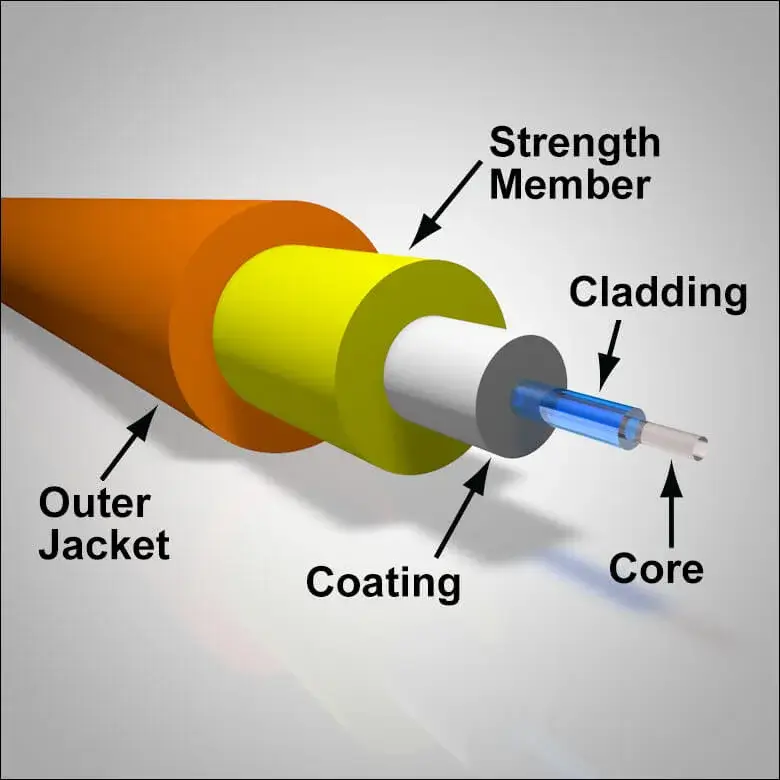
Light travels down a fibre optic cable by bouncing off the walls. Each photon (particle of light) bounces off the wall like a bobsleigh. You probably think that the light would just travel through the exterior glass right? Well, no because if the angle it bounces at is less than 42° then it reflects back in on itself as though it were a mirror. This is called total internal reflection and it means the light will always stay inside the pipe. The cable is also likely to have a cover made from a material with a different refractive index. This means that the light will not be able to refract through it or escape from where it’s meant to be in the cable core. This different material is called the cladding.
The advantages of fibre optics
Copper cables are liable to interference, which causes noise and errors. Optical fibres can travel 10 times further than electrical signals without needing to be boosted. There is no crosstalk, IE interference between cable strands. There is also higher bandwidth, meaning the fibre can handle more information than copper cables. All of this means a more reliable connection that allows more transmission of information, which means faster broadband speeds for you.
What this means for the connection at your house
All of the above describes the cable itself. What decides the speed you actually get is how much of the route to your property is fibre rather than copper. Part fibre, usually sold as fibre to the cabinet, runs fibre as far as the green street cabinet and copper for the last stretch to your door, and that final run of copper is where most of the speed is lost. Full fibre runs the whole way to the building, which is why gigabit packages are possible at all.
Our guide to the difference between cable and fibre broadband covers where Virgin Media fits in, since its network is neither of the two above. To find out which reaches your street, check availability at your address, and if you already have fibre you can test what you are getting against what you pay for. When you are ready to move, compare fibre broadband deals.